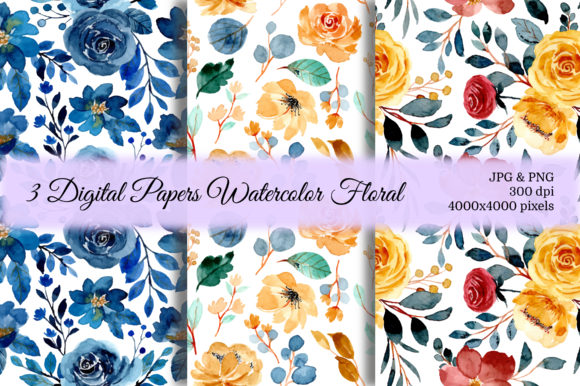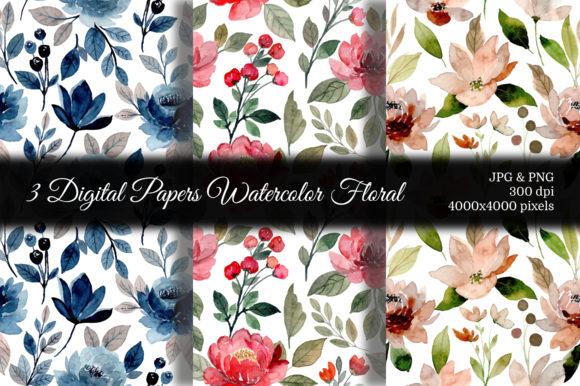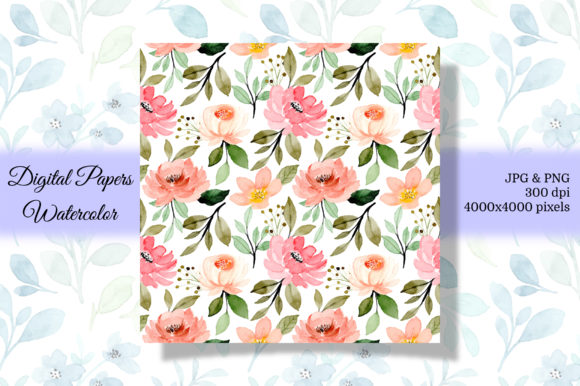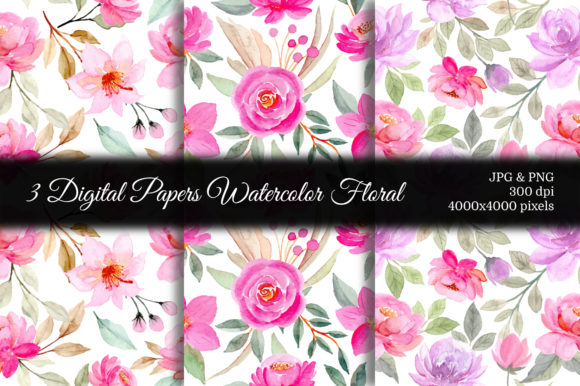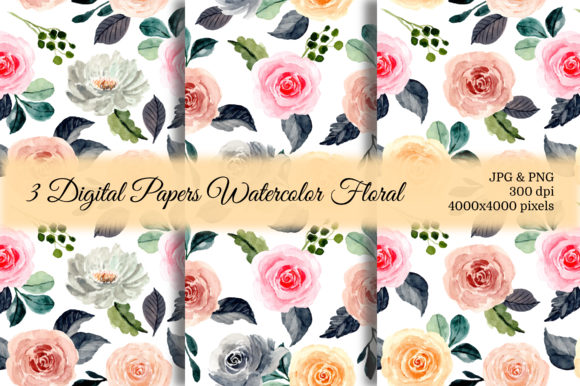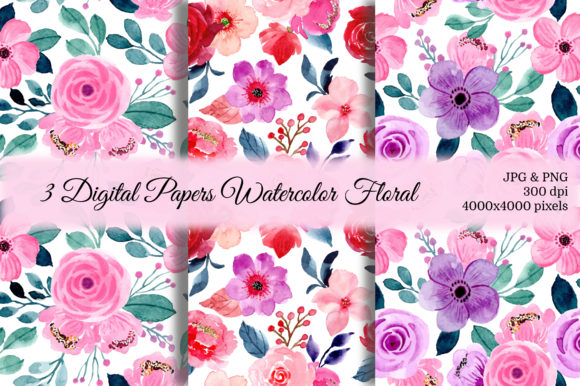
Elevating Creative Projects with Seamless Pattern Floral Watercolor 29
In the expansive world of digital design, finding assets that balance artistic authenticity with technical precision is often a challenge. Designers and crafters frequently encounter patterns that look pixelated when scaled or possess visible seams that disrupt the visual flow. Seamless Pattern Floral Watercolor 29 addresses these common pain points by offering a meticulously crafted collection that bridges the gap between traditional watercolor aesthetics and modern digital utility. This specific asset pack is not merely a set of background images; it is a versatile toolkit designed for high-resolution printing, web design, and digital product creation.
The true value of this collection lies in its duality. By providing both JPG and PNG formats, it acknowledges that creative workflows are rarely linear or singular in purpose. Whether you are designing a physical wedding invitation suite or creating a digital planner sticker set, the technical specifications of your source material dictate the quality of your final output. Understanding how to leverage the 4000×4000 pixel resolution and the 300 DPI standard is essential for maximizing the potential of these digital papers.
Technical Specifications That Define Print Quality
When evaluating digital floral assets, resolution is the non-negotiable metric. The Seamless Pattern Floral Watercolor 29 collection delivers files at 4000×4000 pixels. To put this in practical terms, this dimension allows for substantial scaling without degradation. In print design, the industry standard for crisp, professional results is 300 DPI (dots per inch). At this density, a 4000-pixel square translates to approximately 13.3 inches by 13.3 inches of printable area. This size is significant because it covers standard scrapbook paper sizes, large-format greeting cards, and even sections of textile printing without requiring upscaling algorithms that often introduce artificial blur or noise.
Beyond mere dimensions, the color fidelity and edge definition in these high-resolution files ensure that the delicate washes of watercolor pigment retain their organic texture. Lower resolution patterns often flatten these subtle gradients into banding artifacts, but maintaining 300 DPI preserves the "wet-on-wet" look that makes watercolor so desirable. For designers working on packaging or stationery where tactile visual appeal is paramount, this level of detail ensures the digital file mimics the richness of hand-painted art.
The Strategic Advantage of Dual File Formats
Receiving three images in JPG format and three in PNG format provides immediate workflow flexibility. Many users underestimate the importance of having transparent background options readily available. Here is how the two formats serve distinct functions within a project:
- JPG Files (White Background): These are optimized for speed and compatibility. They are ideal for full-coverage backgrounds, website headers, or digital paper pads where the white base serves as the canvas. Because they lack an alpha channel, file sizes are generally smaller, making them easier to manage in bulk layout software like Adobe InDesign or Canva.
- PNG Files (Transparent Background): Transparency unlocks layering capabilities. With the white background removed, the floral elements can be placed over colored cardstock, textured overlays, or other patterns without carrying a white box around them. This is crucial for creating custom borders, corner embellishments, or overlay effects where the underlying design needs to show through the negative space of the floral arrangement.
Having both formats included eliminates the need for tedious background removal tasks. Automated removal tools often struggle with the semi-transparent edges of watercolor paint, resulting in jagged halos or lost detail. By providing pre-masked PNGs, Seamless Pattern Floral Watercolor 29 saves hours of post-processing time while ensuring the soft, feathered edges of the botanical illustrations remain intact.
Applications Across Industries and Hobbies
The versatility of seamless watercolor florals extends far beyond simple scrapbooking. Modern creators utilize these assets across diverse sectors, each with unique requirements for pattern continuity and aesthetic tone.
Stationery and Event Branding
Wedding and event stationery demand a cohesive visual language. A seamless pattern ensures that when a design wraps around an envelope liner or extends across a folded menu, there are no jarring breaks in the motif. The floral composition in this collection is balanced enough to serve as a primary design element yet subtle enough to act as a backdrop for typography. Designers can use the transparent PNGs to create custom monogram frames or place cards, ensuring the branding feels bespoke rather than templated.
Textile and Surface Pattern Design
For those venturing into print-on-demand products, seamless tiling is critical. When designing for fabric, wrapping paper, or phone cases, the repeat must be invisible. Seamless Pattern Floral Watercolor 29 has been engineered so that the left edge perfectly mirrors the right, and the top aligns with the bottom. This allows designers to fill large surface areas confidently. The watercolor style is particularly popular in the nursery and home decor markets, where soft, organic textures are preferred over sharp vector graphics. The high pixel count ensures that even when printed on yardage, the brushstrokes remain defined.
Digital Product Creation
The rise of digital planning and journaling has created a surge in demand for high-quality digital papers. Users of apps like GoodNotes or Notability seek backgrounds that reduce eye strain while adding aesthetic value. The white-background JPGs function perfectly as page templates, while the transparent PNGs can be imported as stickers or decorative tape elements. Because these are raster images with high resolution, they look sharp on Retina displays and high-DPI tablets, avoiding the fuzziness associated with web-optimized graphics.
Best Practices for Implementation
To fully capitalize on the quality of these digital papers, users should adopt specific handling techniques. First, always work in RGB color mode for digital projects and convert to CMYK only when preparing for professional offset printing. While the files are high resolution, converting color profiles prematurely can dull the vibrant watercolor pigments on screen. Second, when using the transparent PNGs in layered documents, consider utilizing blending modes. Setting a floral layer to "Multiply" or "Overlay" can integrate the pattern more naturally into textured backgrounds, simulating the way real watercolor interacts with paper grain.
Storage and organization also play a role in long-term usability. Given the 4000×4000 pixel size, these files are data-rich. Maintaining a structured asset library with clear tagging—such as "watercolor," "floral," "seamless," and "transparent"—ensures that you can locate the specific variation needed during tight deadlines. Avoid repeatedly saving JPGs, as this format uses lossy compression; always edit from the original master file to prevent generational quality loss.
Evaluating Value in Digital Assets
When selecting floral patterns, creators must look beyond the initial visual appeal. The inclusion of six total variations (three JPG, three PNG) in Seamless Pattern Floral Watercolor 29 represents a comprehensive approach to asset design. It anticipates the user's need for both coverage and compositional freedom. Furthermore, the assurance of a clean white background in the JPGs prevents color casting issues that can occur with off-white or gray-tinted scans, ensuring consistent color grading across multiple projects.
Ultimately, the decision to incorporate this specific collection should be driven by project requirements. If your work involves large-format printing, the 300 DPI specification is mandatory. If your workflow involves complex layering or mixed media collages, the transparent PNGs are indispensable. By understanding these technical and practical nuances, designers can transform a simple download into a foundational element of their creative identity, producing work that looks professionally rendered and artistically authentic.